Big News in Montgomery County
The big story in Montco is a potential land trade that could pave the way for industrial development along the Schuylkill River up here.
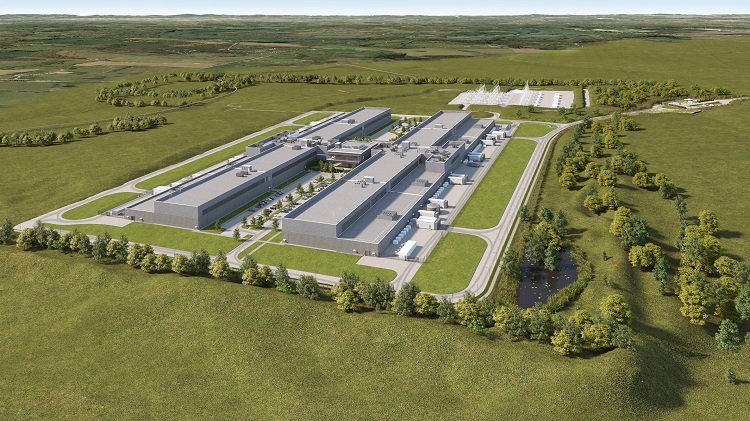
A warehouse developer’s proposal to trade land with the state in Limerick Township and beyond has blindsided local officials — and ignited fierce opposition from residents who fear the deal could clear the path for a hyperscale data center — a massive facility designed to handle huge amounts of data and consume huge amounts of power. The state would gain 559 acres across three counties, including what would become Delaware County’s first state game lands, according to the proposal on file with the Pennsylvania Game Commission.
In return, the developer, Limerick Town Center LLC, would secure a 55-acre property in Limerick. That land adjoins an industrial tract the developer already owns, which was formerly the site of the Publicker distillery.
State Sen. Katie Muth (D-44) and local residents worry that the more buildable site could attract data center development, echoing recent opposition to another 1.4-million-square-foot facility proposed nearby.
Muth and others have warned about the potential strain a data center could place on local resources. Data centers typically rely on large amounts of electricity and substantial water usage to cool equipment.
Limerick Township Manager Dan Kerr confirmed no formal application has been submitted yet, but the property qualifies for the township’s data center overlay district. The site, between the cooling towers of the Limerick Generating Station and the Philadelphia Premium Outlets, could eventually house a facility that supports artificial intelligence operations.
“The cloud is stored in these massive buildings,” says Township Manager Daniel Kerr.
Kerr says that the proposed data center meets local land use rules and the data center usage is permitted in the zoning district that they’re in,” said Kerr.
But it’s up to the local government to set parameters on what is built there, and how.
“The conditional use allows the board of commissioners to place additional conditions on a project,” said Kerr. “Setting height, sound and other related environmental standards.”
John Quigley, senior fellow at the Kleinman Center for Energy Policy at the University of Pennsylvania, said any proposal of this scale should be evaluated for its environmental and economic impact.
“What are the impacts in terms of air quality, noise pollution, light pollution?” he said.
Quigley also raised concerns about cost.
“Consumers are subsidizing these data centers. You’re paying more in your electricity bill because of data centers,” he said.
The swap also includes a right-of-way for road access and consolidates game lands elsewhere. The outcome could influence industrial development and public land protection in the community. Limerick Township was slated to decide whether to send a formal letter in opposition to the swap on Jan. 20. Muth is urging residents to speak out to the Game Commission against the exchange. “I know 8:30 a.m. on a Saturday in Harrisburg is a big ask, but this moment matters. If we don’t show up, these decisions get made without us. You can also make your voice heard ahead of time by contacting the Game Commissioners directly at [email protected],” she wrote. “Public land should stay public.”
Source: Pottstown Mercury, 1/19/2026
How Could a Hyperscale Data Center affect Residents?
Residents living near hyperscale data centers often see higher electric bills because these facilities place an unusually large and constant demand on the local power system, which affects how electricity is generated, transmitted, and priced.
First, hyperscale data centers consume enormous amounts of electricity 24/7, often comparable to a small city. To serve this demand, utilities may need to build new substations, transmission lines, or power plants. While data center operators sometimes contribute to these costs, a significant portion of grid upgrades is frequently spread across the utility’s entire customer base through rate increases, meaning nearby households help pay for infrastructure built primarily to serve the data center.
Second, large data centers can strain local grids, especially during peak demand periods or heat waves. To maintain reliability, utilities may rely on more expensive “peaking” power plants or purchase power on the wholesale market at higher prices. These higher operating costs are typically passed on to residential customers through fuel adjustment charges or rate hikes.
Third, data centers can drive up wholesale electricity prices in the region. Because they buy massive amounts of power, they can change local supply-and-demand dynamics, particularly in constrained areas where generation or transmission capacity is limited. When demand increases faster than supply, electricity prices rise for everyone connected to that grid.
Finally, while data centers often receive tax abatements, discounted electric rates, or economic incentives to attract them to an area, residents usually do not receive comparable relief. This can create a perception—and often a reality—that households are paying more while large corporate users benefit from preferential treatment.
In short, residents’ electric bills tend to rise near hyperscale data centers because the costs of expanding and stabilizing the power grid, managing higher peak demand, and purchasing more expensive electricity are frequently shared across all ratepayers, even though the primary driver of that demand is the data center itself.
Power and Water Requirements
Hyperscale data centers — the massive facilities built for cloud services, artificial intelligence, and internet-scale computing — consume very large amounts of both electricity and water compared with typical commercial buildings or smaller IT facilities. These resource demands come from two main needs: powering tens of thousands of servers around the clock, and cooling that equipment so it doesn’t overheat.
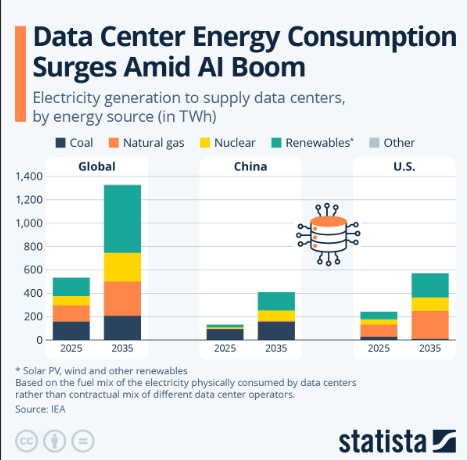
In terms of power, data centers in the United States alone used an estimated around 183 terawatt-hours (TWh) of electricity in 2024, which is more than 4 % of total U.S. electricity consumption — and much of that comes from hyperscale facilities because they host the largest computing loads. Within that national figure, a single AI-focused hyperscale data center can consume as much electricity annually as about 100,000 households, and the largest new facilities under construction may draw up to twenty times that amount. Projections suggest U.S. data center electricity use could grow dramatically by 2030 as demand for AI and cloud services accelerates.
For water use, the numbers are similarly striking. Hyperscale sites typically rely on evaporative cooling systems that require significant water input to remove heat from servers. Estimates indicate that a large hyperscale data center can use between roughly 1 million and 5 million gallons of water per day for cooling alone — amounts comparable to the annual water consumption of a small town or the needs of thousands of households. Over the course of a year, this can translate into hundreds of millions to over a billion gallons of direct water use at a single facility, depending on its design and the local climate. In the United States, data centers as a whole directly consumed about 17 billion gallons of water in 2023, with hyperscale and colocation facilities accounting for the vast majority and expected to use 16 billion to 33 billion gallons annually by 2028.
Beyond this direct consumption, there is also a significant indirect water footprint associated with electricity generation: many power plants that supply data centers require water for cooling and steam production, multiplying the total water impact tied to data center electricity use.
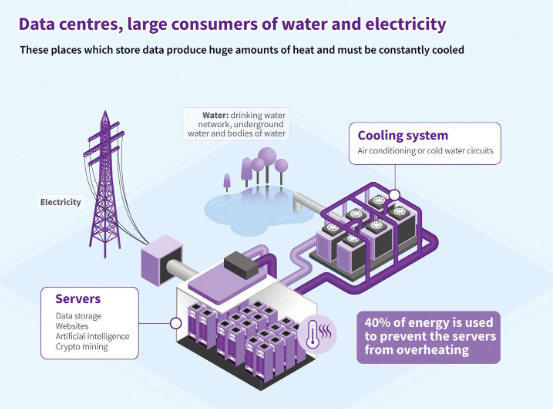
In summary, hyperscale data centers are among the most energy-intensive and water-intensive industrial operations in the modern economy — drawing hundreds of megawatts of continuous power and millions of gallons of water daily — and these demands are expected to grow substantially as digital and AI services expand.
Pros/Cons of living near a data center
Here is a breakdown of the pros and cons of having a hyperscale data center in an area you reside:
Pros
- Significant Tax Revenue: Data centers can be a major source of revenue for local governments through property taxes on buildings and, in some states, taxes on the equipment inside (servers, storage). This can reduce the overall tax burden on residents and fund public services like schools, roads, and infrastructure.
- Economic Growth & Investment: These projects are capital-intensive, often costing hundreds of millions to billions of dollars, which drives investment into the local economy.
- Job Creation (Construction): They create high-paying jobs, particularly during the construction phase, which can last for years.
- Lower Traffic/Pollution than Industrial Use: Compared to manufacturing plants or large warehouses of similar size, data centers often have a smaller long-term traffic and pollution footprint during daily operations.
- Infrastructure Improvements: To support the high power demands, data centers often drive upgrades to local electrical grids, which can benefit the broader community.
Cons
- Massive Power Strain: A single hyperscale facility can consume hundreds of megawatts, comparable to the demand of a small city, which can stress local grids and potentially raise energy costs for residents.
- High Water Usage: Many data centers use millions of gallons of water annually for cooling, which can be critical in drought-prone areas or strain local water supplies.
- Minimal Long-Term Employment: While they create many temporary construction jobs, they are highly automated and require few permanent employees (often fewer than 50).
- Noise Pollution: The cooling systems and backup generators can generate significant noise, which can be a nuisance for nearby residential areas.
- Environmental Concerns & Land Use: They require vast amounts of land and, in some cases, backup generators can emit pollutants that affect local air quality.
- Disruption During Construction: The initial construction phase can cause significant traffic, noise, and disruption to local residents.

Do you need real estate services?
Contact Us!
Contact our offices in Pottstown or Collegeville!
Collegeville: 610-489-5900
Pottstown: 610-326-1200
OR through our social media pages!
Facebook and Instagram at “REMAXAchieversAgentsinPA”
Instagram:
Facebook:
https://www.facebook.com/SouthEasternPARealEstateSalesAgents
How RE/MAX Achievers Can Help You!
With talented and award-winning realtors, years of experience, and thousands of happy customers, you know that you can trust RE/MAX Achievers with all your home needs! Whether you’re buying or selling in or around the Royersford real estate market, RE/MAX Achievers is here to help. We know more than anybody the stress that comes with the Royersford real estate market, and we don’t want you to face it alone! Everybody deserves the home they love, and we want to help you find it!
RE/MAX Achievers sold over $1 Billion Dollars in real estate during the last 5 years! RE/MAX was voted 2024’s number one real estate brand. RE/MAX Achievers Broker/Owner, John E. Ohler has stated he “is so proud of our accomplishments thanks to the surrounding communities. RE/MAX is a household name!” RE/MAX Achievers was awarded the 2022 RE/MAX President Club Award and the 2022, 2021, 2020, 2019, 2018 RE/MAX Achievement of Excellence Award! RE/MAX was voted the 2024, 2023, 2022 MOST Trusted Real Estate brand and agents. RE/MAX Achievers offers real estate services in 5 counties: Montgomery, Chester, Berks, Bucks and Philadelphia counties. There’s truly nobody more fit to help you with buying a home in the Pottstown real estate market.
Don’t stress about buying or selling a home in the Royersford real estate market! Call the Achievers today!